Followers

Showing posts with label UNESCO World Heritage. Show all posts

Saturday, September 29, 2018

Kostnice v Sedlci - SPOOKY!

The Sedlec Ossuary, also known as the Church of Bones, is located in a suburb of Kutná Hora, Czech Republic. It takes around 15-20 minutes from the main station by a walk. 


The history of Kutná Hora, located in Central Bohemia, dated back to 1142 with the settlement of Sedlec Abbey which is the first Cistercian monastery in Bohemia. It was brought from the Imperial immediate Cistercian Waldsassen Abbey. The Sedlec Ossuary is a part of the former Sedlec Abbey.


In1995 the city center is listed as UNESCO World Heritage Site. The ossuary is among the most visited tourist attractions of the Czech Republic - attracting over 200,000 visitors annually.


I fully understand its popularity as soon as I stepped in a small Roman Catholic chapel located beneath the cemetery of all Saints.


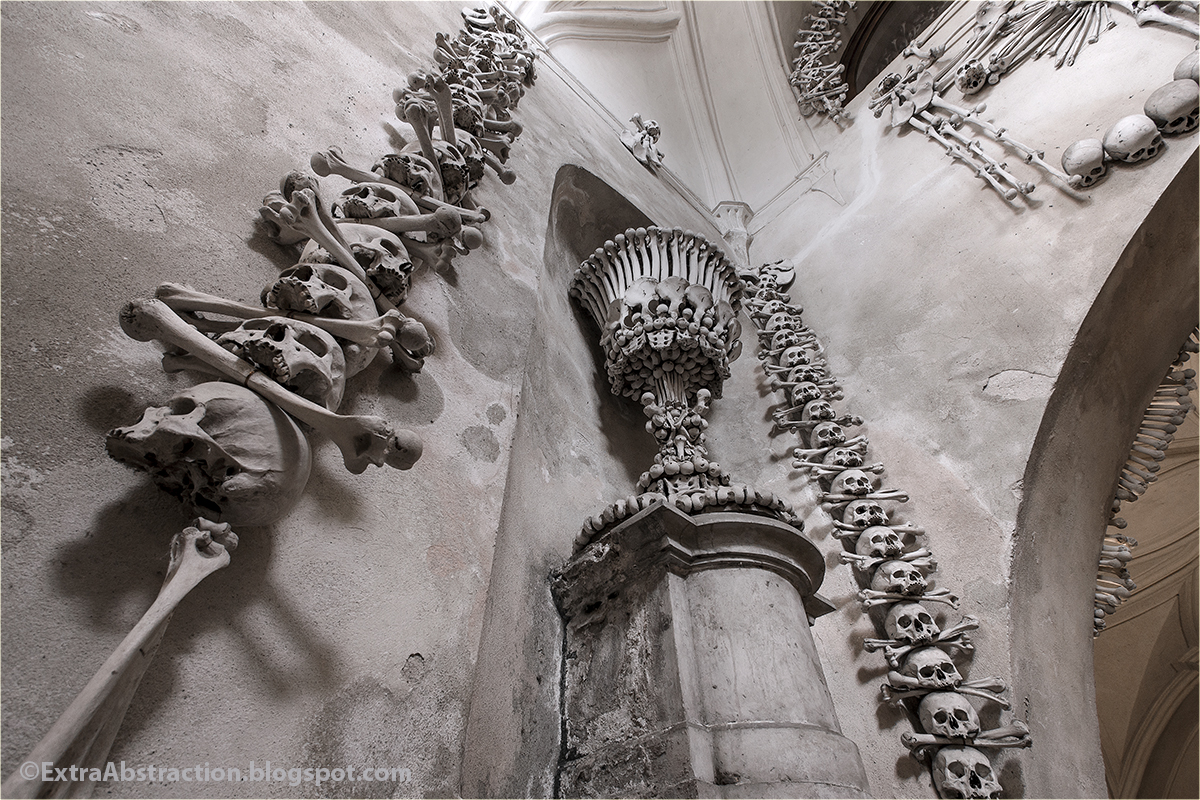
Close to the entrance, bone chalices are displayed on both sides of stairs.
Bone chalice on the left

The ossuary is estimated to contain the skeletons of between 40,000 and 70,000 people, whose bones have, in many cases, been artistically arranged to form decorations and furnishings for the chapel. The bone decorations were made by Czech carpenter, František Rint, who was employed by the  Schwarzenberg family in 1870.


Schwarzenberg Family coat-of-arms

Enlarged front view of above image
You may wonder why a myriad of human bones was there?


It is very symbolic that Sedlec abbey cemetery became a desirable burial site throughout Central Europe because of the fact that, in 1278, Henry, abbot of the Cistercian monastery in Sedlec, went to the Holy Land, returned with a small amount of earth he had removed from "Golgotha (=skull)" and sprinkled it over the abbey cemetery...


As a result of the devastating pandemic of the Black Death (Great Plague) in the mid 14th century and the following Hussite Wars in the early 15th century, many thousands were buried in the abbey cemetery. The cemetery had to be expanded to accommodate them.


Around 1400, a Gothic church was built in the center of the cemetery with a vaulted upper level and a lower chapel to be used as an ossuary for the mass graves unearthed during construction, or simply slated for demolition to make room for new burials... Well, then, such bones from approximately 10,000 were showcased.


Chandelier made of skulls and bones
The most eye-catching decoration in the vault is probably the enormous chandelier of bones that contains at least one of every bone in the human body. Beneath it lie four bell-shaped mounds that also draw your attention.


It was worth visiting there!


Sunday, November 26, 2017

Wieliczka Salt Mine

Wieliczka Salt Mine (Polish: Kopalnia soli Wieliczka) had been one of my "must-visit" destinations until this summer in 2017, although it's not so far from where I currently live (Olomouc, Czech Republic). It is located in Wieliczka within the Kraków metropolitan area. 


The salt mine, run by the Żupy krakowskie Salt Mines company, was one of the oldest mines that history dated back to the 13th century and kept producing table salt until 2007. Commercial mining was discontinued in 1996, because of salt prices going down and also mine flooding. The mine is one of Poland's official national Historic Monuments (Pomniki historii), as designated in the first round, on 16 September 1994. About 1.2 million people visit the Wieliczka Salt Mine annually!!!

Image from Wiki
In Krakow, millions of tourist offices offer guide tours. The guide tour price varies according to the service - the more expensive tour tends to include a pick-up service in front of your hotel - No need to take public transportation, and no need to buy a tour guide when you get there. 


Chapel of Saint Kinga

Joining a guided tour means you are obliged to follow your guide as a group of around 30 visitors. You are not allowed to be alone there. In another word, being alone in the mine means you are likely to get lost in humongous underground salt world!
Rock-salt carving of Pope John Paul II
After setting up the radio headphone, the following action visitors make in the tour is to come down the everlasting stairs to a depth of 64 meters. By following a guide's voice through the radio-headphone over walking almost 3 km (which is still less than 2% of the length of the mine's passages!!!) of meandering corridors, you encounter stunning beauty of chapels, statues, and reception room that are all made of salt, as well as underground lake located at 135 meters in depth. 


Underground lake in Wiemar Chamber
If you haven't been to, I strongly recommend visiting there to indulge yourself in the crystal beauty of past industrial technologies and the faith among hardworking miners.

Casimir III the Great (left)
From time to time during the tour, you encounter well-carved statues. The bust of Casimir III the Great (1310-1370) can be found in a more than 100-meter underground corridor. Of course, he is made of salt rock carved by miners. He is called "the Great" because he was deemed a peaceful ruler, a “peasant king,” and a skilled diplomat. He reformed the Polish army and doubled the size of the kingdom. He reformed the judicial system and introduced a legal code, gaining the title "the Polish Justinian". He was the founder of the University of Kraków, the oldest Polish university. He also confirmed privileges and protections previously granted to Jews and encouraged them to settle in Poland in great numbers. 


He is portrayed in 50 Złoty.

St. John Chapel
The Chapel of St. John, a symbol of Wieliczka miners' faith and worship, is considered to be the most beautiful chapel with wooden furnishings. It is located 135 meters underground with a floor area of 153 square meters. It appears at the very end of the tour. Make sure your camera battery is still alive and still enough space in the memory card...

Chapel of Saint Kinga
There is no doubt that the Chapel of St. Kinga, located 101 meters underground with 31 x 15 m dimensions/ 465 square meters, is the biggest highlight of the tour. When you search for images of Wieliczka Salt Mine, you are very likely to find images of this chapel. Due to the tour, I could only stay around 12 min.... Way too short!

All made of salt!!!

There is a legend about Saint Kinga of Poland (1224-1292). Well, she was a Hungarian princess born in Esztergom in the Kingdom of Hungary. When She was betrothed to Bolesław V the Chaste, the Prince of Kraków in the 1200s, she persuaded her father, Béla IV of Hungary, for a lump of salt because Krakow had lots of gold but hardly any salts then.  Before Kinga headed for Kraków, her father King Béla took her to a salt mine in Máramaros county in Hungary where she threw her engagement ring given by her fiancé, Bolesław, in one of the shafts. Upon arriving in Kraków, she asked the miners to dig a deep pit until they come upon a rock. The people found a lump of salt in there and when they split it in two, discovered the princess's ring. Kinga had thus become the patron saint of salt miners in and around the Polish capital. Her discovery of a salt mine had brought Kraków 700 years of wealth through salt export.
Michalowice Chamber
Michalowice Chamber is another breathtaking timber-made structure built by mimers you encounter. jaw-dropping view!!!

Souvenir shop
I am not sure if the "embedded" souvenir shop was also made by miners... but so cool!


In 1978 it was placed on the 
first UNESCO list of World Heritage Sites.


Monday, August 3, 2015

Mosteiro dos Jerónimos

The Jerónimos Monastery/Hieronymites Monastery is located near the shore of the parish of Belém in Lisbon. This is probably the most impressive symbol of Portugal's power and wealth during the Age of DiscoveryIn 1983, along with Belém Tower, it was classified a UNESCO World Heritage site.


The construction of the monastery and church was inaugurated on the order of King Manuel I in 1502 and the initial planned construction period was only 8 years, however, in reality, it was completed 100 years later!!! Thanks to the unprecedentedly rich influx of tax on commerce from Africa and the Orient, the architects were not limited to small-scale plans.


Soon after entering the western portal of the Church of Santa Maria, there are two stone thumbs, Vasco da Gama and  Luís de Camões who is the greatest poet and chronicler of the Age of Discoveries. Both tombs were sculpted by Costa Mota, tio in a harmonious neo-Manueline style. The mortal remains of both were transferred to these tombs in 1880.


On December 13th, 2007, the Treaty of Lisbon was signed at the monastery.


Friday, January 16, 2015

Padrão dos Descobrimentos

This is part 3 entry of Belém (Lisbon).


The fifty-meter tall Padrão dos Descobrimentos (Monument to the Discoveries) shaped like a ship's prow, can be found on the northern bank of the Tagus River estuary. For sure, it represents a romanticized idealization of Portuguese exploration!

That's where Vasco da Gama embarked on his voyage to India in 1497 and also where Christopher Columbus had to anchor his ships due to the storm on his way back to Spain after his triumphal discovery of the Americas. It's around 900 meters away from Belém Tower, BTW.


The monument was built in 1960 on the occasion of the 500th anniversary of Henry the Navigator's death. It should be noted that the monument we see today is the replica of the original one that was built for the Portuguese World Fair opening in June 1940. The original monument was demolished after the exposition. 


Great people on the western side
In total, there are 33 figures along two sides of the monument. That includes great people with a variety of occupations and each idealized figure is designed to show movement toward the unknown sea.


Have a wonderful weekend.

Saturday, January 3, 2015

Torre de Belém

Happy New Year!

The 1st entry of 2015 is from Lisbon. The photos were taken during my Christmas vacation in my beloved country, Portugal!


Torre de Belém is located in the southwesternmost civil parish of Santa Maria de Beléin the municipality of Lisbon. Belém is derived from the Portuguese word for Bethlehem. 


Along with Jerónimous Monastery, the Tower of Belém is registered as UNESCO World Heritage Site. The tower was built on a small island in the Tagus River near the Lisbon shore in the Age of Discoveries.


I enjoyed what the parish of Belém has to offer. There are numerous architectures and places for shooting - Padrao dos Descobrimentos (Monument to the Discoveries), Museu Nacional de Arqueologia (National Archaeology Museum), Museum da Marinha (Navy Museum), Centro Cultural de Belém (Cultural Centre of Belém), Museu da Electricidade (Electricity Museum) and so on...  

Image from Wiki

Pastel de nata (egg tart pastry) was very yummy, BTW! It is a "must-visit" shop!